It's official: "Not Cool" is not a persuasive legal argument.
Thursday, November 02, 2006


When did wanting to pay less tax become a criminal offense?
Some people are all up in arms, accusing U2 of cheating on their taxes becuase they moved their publishing company's headquarters out of Ireland and to the Netherlands to take advantage of lower tax rates.
These people are out of their friggin' minds.
Folks, this is not cheating on taxes. Not even close. It's a fundamentally sound, albeit tax-motivated, business decision. Or, as the Edge called it, "tax-efficient."
Companies do this every single day. Heck, it's why I continue to live in Virginia instead of Maryland or D.C.
These people are out of their friggin' minds.
Folks, this is not cheating on taxes. Not even close. It's a fundamentally sound, albeit tax-motivated, business decision. Or, as the Edge called it, "tax-efficient."
Companies do this every single day. Heck, it's why I continue to live in Virginia instead of Maryland or D.C.
Whaaaa?
This confounds me:
Thanks, Yahoo! News.
Amanda Brisendine attributed the 30 pounds she gained in the past year to an abandoned smoking habit and rich food. So when she went to the hospital with sharp stomach pain, she wasn't expecting to leave with a newborn son.
***
George Macones, chairman of the OB/GYN department at Washington University in St. Louis, said he's seen about a dozen cases in his nearly 20-year career.
***
The 26-year-old Renton woman went to Group Health Cooperative's Eastside campus last Saturday after experiencing several days of abdominal pain so intense that she called in sick from work. Doctors examined her and performed a pregnancy test that showed positive — she was nine months pregnant.
***
Already mother to a 14-month-old daughter, Melodies, Brisendine said she didn't experience typical pregnancy symptoms, like a missed menstruation, morning sickness, fatigue or food cravings. "Everything was normal as far as I knew," she said.
Thanks, Yahoo! News.
Wednesday, November 01, 2006
Today in politics
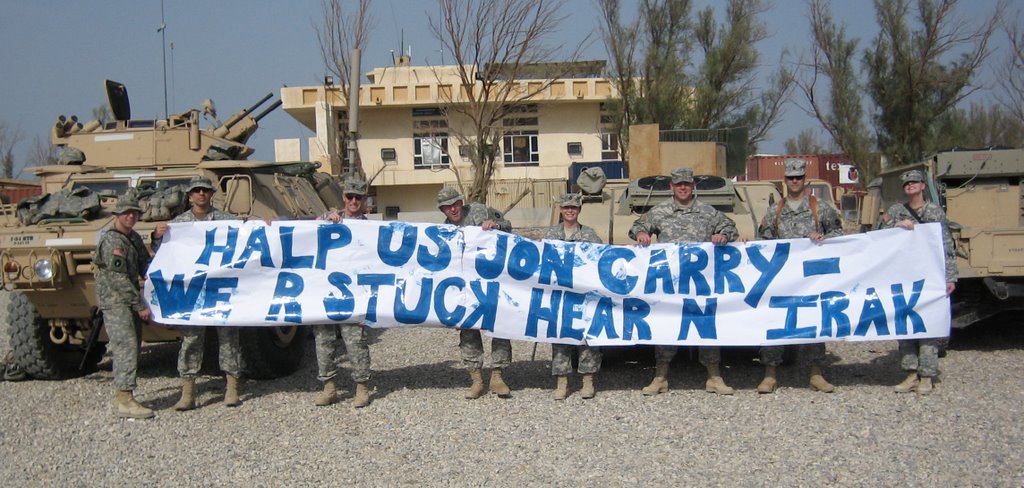
It's the first day of November. The midterm election is just days away. And, just like the script says, John Kerry makes an offhand comment interpreted as insulting soldiers, all for a laugh. (Talk about "Here it goes again" . . .)
Free Republic posted this picture, which is a perfectly defensible response to the purported meaning of the Kerry comment:

Justin thinks that the Democrats will win the House, not the Senate. I'm skeptical about whether they can win anything, even with it being handed to them on a silver platter. John Kerry's stupidity is just a symptom of a much larger ineffectiveness that the majority of Democrats seem to find inescapable.
As crazy as it sounds, at least Al Sharpton had something intelligent to say today. He's right that focusing on moral issues is not a way to cure the majority of society's problems. Still, I don't know that bashing the Christian right is the way to change things.
And finally, from Professor Geoffrey R. Stone's commentary in the Chicago Tribune, What it means to be a liberal, here are his 10 defining characteristics:
I don't know that it's exhaustive, but it's a good start.
Update: Michael J. Fox says that even Alex P. Keaton would be fed up with the Republicans over stem-cell research. I think that might be an exaggeration. For the record, Alex Keaton was a fan of Reagan and Nixon. And, from what I've been told, even though those that hew closely to a Conservative political philosophy (small government, lassez-faire, individual liberty, etc.) aren't big fans of the current administration, they wouldn't throw out the baby with the bathwater by voting for the Dems.
More importantly, read Lou Dobbs, who says that no matter which major party wins, middle class America is getting screwed:
I wish I had written that line about the bird. Fucking brilliant.
Free Republic posted this picture, which is a perfectly defensible response to the purported meaning of the Kerry comment:
Justin thinks that the Democrats will win the House, not the Senate. I'm skeptical about whether they can win anything, even with it being handed to them on a silver platter. John Kerry's stupidity is just a symptom of a much larger ineffectiveness that the majority of Democrats seem to find inescapable.
As crazy as it sounds, at least Al Sharpton had something intelligent to say today. He's right that focusing on moral issues is not a way to cure the majority of society's problems. Still, I don't know that bashing the Christian right is the way to change things.
And finally, from Professor Geoffrey R. Stone's commentary in the Chicago Tribune, What it means to be a liberal, here are his 10 defining characteristics:
1. Liberals believe individuals should doubt their own truths and consider fairly and open-mindedly the truths of others. This is at the very heart of liberalism. Liberals understand, as Justice Oliver Wendell Holmes once observed, that "time has upset many fighting faiths." Liberals are skeptical of censorship and celebrate free and open debate.
2. Liberals believe individuals should be tolerant and respectful of difference. It is liberals who have supported and continue to support the civil rights movement, affirmative action, the Equal Rights Amendment and the rights of gays and lesbians. (Note that a conflict between propositions 1 and 2 leads to divisions among liberals on issues like pornography and hate speech.)
3. Liberals believe individuals have a right and a responsibility to participate in public debate. It is liberals who have championed and continue to champion expansion of the franchise; the elimination of obstacles to voting; "one person, one vote;" limits on partisan gerrymandering; campaign-finance reform; and a more vibrant freedom of speech. They believe, with Justice Louis Brandeis, that "the greatest menace to freedom is an inert people."
4. Liberals believe "we the people" are the governors and not the subjects of government, and that government must treat each person with that in mind. It is liberals who have defended and continue to defend the freedom of the press to investigate and challenge the government, the protection of individual privacy from overbearing government monitoring, and the right of individuals to reproductive freedom. (Note that libertarians, often thought of as "conservatives," share this value with liberals.)
5. Liberals believe government must respect and affirmatively safeguard the liberty, equality and dignity of each individual. It is liberals who have championed and continue to champion the rights of racial, religious and ethnic minorities, political dissidents, persons accused of crime and the outcasts of society. It is liberals who have insisted on the right to counsel, a broad application of the right to due process of law and the principle of equal protection for all people.
6. Liberals believe government has a fundamental responsibility to help those who are less fortunate. It is liberals who have supported and continue to support government programs to improve health care, education, social security, job training and welfare for the neediest members of society. It is liberals who maintain that a national community is like a family and that government exists in part to "promote the general welfare."
7. Liberals believe government should never act on the basis of sectarian faith. It is liberals who have opposed and continue to oppose school prayer and the teaching of creationism in public schools and who support government funding for stem-cell research, the rights of gays and lesbians and the freedom of choice for women.
8. Liberals believe courts have a special responsibility to protect individual liberties. It is principally liberal judges and justices who have preserved and continue to preserve freedom of expression, individual privacy, freedom of religion and due process of law. (Conservative judges and justices more often wield judicial authority to protect property rights and the interests of corporations, commercial advertisers and the wealthy.)
9. Liberals believe government must protect the safety and security of the people, for without such protection liberalism is impossible. This, of course, is less a tenet of liberalism than a reply to those who attack liberalism. The accusation that liberals are unwilling to protect the nation from internal and external dangers is false. Because liberals respect competing values, such as procedural fairness and individual dignity, they weigh more carefully particular exercises of government power (such as the use of secret evidence, hearsay and torture), but they are no less willing to use government authority in other forms (such as expanded police forces and international diplomacy) to protect the nation and its citizens.
10. Liberals believe government must protect the safety and security of the people, without unnecessarily sacrificing constitutional values. It is liberals who have demanded and continue to demand legal protections to avoid the conviction of innocent people in the criminal justice system, reasonable restraints on government surveillance of American citizens, and fair procedures to ensure that alleged enemy combatants are in fact enemy combatants. Liberals adhere to the view expressed by Brandeis some 80 years ago: "Those who won our independence ... did not exalt order at the cost of liberty."
I don't know that it's exhaustive, but it's a good start.
Update: Michael J. Fox says that even Alex P. Keaton would be fed up with the Republicans over stem-cell research. I think that might be an exaggeration. For the record, Alex Keaton was a fan of Reagan and Nixon. And, from what I've been told, even though those that hew closely to a Conservative political philosophy (small government, lassez-faire, individual liberty, etc.) aren't big fans of the current administration, they wouldn't throw out the baby with the bathwater by voting for the Dems.
More importantly, read Lou Dobbs, who says that no matter which major party wins, middle class America is getting screwed:
It's amazing what a mere $2.6 billion can buy in a democracy. That's what the two parties will have spent in their campaigns leading up to these midterm elections, according to the Center for Responsive Politics. And most of that money for Democrats and Republicans alike comes from corporate America. So what will be the outcome of this election? The only certainty is that corporate America will get what it's paid for, and that's more of the same.
***
While the name of the party in charge may change from Republican to Democrat, it's really only a branding issue. And just as my friend James Mtume says, it's still the same bird, just a different wing. And believe me, middle-class America will still be getting the bird.
Neither party at the national or local level is talking about what to do about the education crisis in our public schools. Both parties seem to think a 10-year plan to measure the decline of our schools through the No Child Left Behind law is an adequate response to what is an outright emergency.
Both parties seem happily content to give their multinational corporate masters exactly what they want in the form of so-called free trade, which has cost millions of middle-class Americans their jobs to outsourcing and off-shoring of manufacturing production to cheap overseas labor markets.
And God forbid we should disturb the orthodoxies of both parties that insist that we not secure our borders and ports, despite radical Islamist terrorist threats, the multibillion-dollar illegal drug trade and what is nothing less than an invasion of illegal aliens into this country.
I wish I had written that line about the bird. Fucking brilliant.
John Mayer
Dave Navarro used to be my favorite blogging musician -- and it's not that I don't still love him -- it's just that John Mayer is friggin' hilarious. (If you don't believe me, read his Rolling Stone interview from a couple weeks ago.) And his new album is pretty good, too.
I just wish his tv show was still on.
I just wish his tv show was still on.
Tuesday, October 31, 2006
Here It Goes Again
I just wanted to post this because it makes me happy.
The downside is that, on the rare occasions when I actually get to run on the treadmill, all I can think about is this dance.
The downside is that, on the rare occasions when I actually get to run on the treadmill, all I can think about is this dance.
Violent crime in Pentagon City
Today, there was another incident of violent crime in my neighborhood:
At least no one got shot like last time.
At least one gunman, and possibly two, attacked an armored car guard at the Pentagon City mall in Arlington this afternoon and got away with an undisclosed amount of money, police said.
No one was injured in the robbery, during which shots were fired.
***
In the corridor behind the bank, there was a struggle with one or two suspects during which a bag of money was taken from one of the guards and a weapon fired. The other guard was still in the armored vehicle, police said.
At least no one got shot like last time.
Dream v. Reality
Maybe Justin is right and my ghost really was a dream. But if so, what did it mean?
Too bad I didn't have the Post to help back then. But today, I found this helpful guidance:
Too bad I didn't have the Post to help back then. But today, I found this helpful guidance:
Riiiight. I guess that's what Richard Linklater meant with that weird movie.Ask any professional with dream experience, and their message is clear: Ignore quick-fix dream "doctors" on TV and the Internet. Toss your conventional dream dictionaries to the curb -- they are too strict, too patrician.
And their meanings? Meaningless.
It's common sense, really. Many people dream about cats, but not all dream that cats are manifestations of one's mother, as Freud suggested.
"After all, a dream about a house must mean different things to a carpenter and an arsonist," says Karen Shanor, a clinical psychologist who runs a private practice in Northwest Washington.
Dreams should be worked rather than cut and dried into categories, Shanor, Delaney and others say. No book -- and no one -- can tell you what your dreams mean, since one's dreaming life can be understood only in the context of one's waking life.
Ghost story
Scientists keep trying to prove that vampires, ghosts, and other supernatural entities aren't real, but so far, all either side has managed to yield are logical reasons why such entities can't exist. But as much as I respect rationality, some things just defy logic.
As mentioned in my 100 things post, I once thought that I might have seen a ghost (#72). In the spirit of Halloween, I thought I'd elaborate.
Note that (1) this is, indeed, a true story; (2) I haven't told all that many people about it; and (3) last time I checked, I'm not certifiably insane.
First I should issue a little disclaimer: Pretty much my entire life, I've lived in new -- or relatively new places. The exceptions were my college dorms and the flat I lived in during my study abroad program in London. So, assuming that ghosts are tied to places of emotional significance for them, there was pretty much no chance of me running into one.
Anyway, during the summer of '97 -- midway through my law school career -- my brother and I spent part of the summer in New York City, celebrating his graduation from high school. For one week of this trip, we stayed in my aunt's friend's pre-war apartment on the Upper West Side, essentially as housesitters while she was on vacation. Only the back bedroom -- the guest room -- was air conditioned. My brother slept there.
I slept in the master bedroom in the front of the apartment. Since it didn't have air conditioning, to be able to sleep, I needed to turn on a fan and open the window. Generally, with the window open, I heard some traffic noise, but no discernable conversations. Mostly, they were masked by the sound of the fan, but the fact that my brother and I tended to keep pretty late hours didn't hurt.
On these hot summer nights, it usually took me a while to fall asleep. So, I'd toss and turn for a while, in the room full of white noise, trying to find a cool, comfortable position. One of these nights, in that gray area between awake and asleep, I had a conversation with a soldier.
I don't recall the specifics of the conversation. What I do remember is the feeling that he belonged in Gail's apartment more than I did.
Anyway, the rest is equally vague. What I remember is that eventually, I figured out that it wasn't normal, and I sat up, wide awake -- but by then, it was over and he was gone. I somehow convinced myself that it was just a dream, and managed to fall back to sleep.
So there you have it. My ghost story. It could have been anything, or nothing -- and indeed, it probably was nothing. But there's this teensy little part of me that likes to believe that there's something out there more than what we see, more than can be easily explained. And that little corner of my mind isn't completely convinced that I was dreaming.
Update: In keeping with the holiday, try some virtual pumpkin carving. Here's mine:

As mentioned in my 100 things post, I once thought that I might have seen a ghost (#72). In the spirit of Halloween, I thought I'd elaborate.
Note that (1) this is, indeed, a true story; (2) I haven't told all that many people about it; and (3) last time I checked, I'm not certifiably insane.
First I should issue a little disclaimer: Pretty much my entire life, I've lived in new -- or relatively new places. The exceptions were my college dorms and the flat I lived in during my study abroad program in London. So, assuming that ghosts are tied to places of emotional significance for them, there was pretty much no chance of me running into one.
Anyway, during the summer of '97 -- midway through my law school career -- my brother and I spent part of the summer in New York City, celebrating his graduation from high school. For one week of this trip, we stayed in my aunt's friend's pre-war apartment on the Upper West Side, essentially as housesitters while she was on vacation. Only the back bedroom -- the guest room -- was air conditioned. My brother slept there.
I slept in the master bedroom in the front of the apartment. Since it didn't have air conditioning, to be able to sleep, I needed to turn on a fan and open the window. Generally, with the window open, I heard some traffic noise, but no discernable conversations. Mostly, they were masked by the sound of the fan, but the fact that my brother and I tended to keep pretty late hours didn't hurt.
On these hot summer nights, it usually took me a while to fall asleep. So, I'd toss and turn for a while, in the room full of white noise, trying to find a cool, comfortable position. One of these nights, in that gray area between awake and asleep, I had a conversation with a soldier.
I don't recall the specifics of the conversation. What I do remember is the feeling that he belonged in Gail's apartment more than I did.
Anyway, the rest is equally vague. What I remember is that eventually, I figured out that it wasn't normal, and I sat up, wide awake -- but by then, it was over and he was gone. I somehow convinced myself that it was just a dream, and managed to fall back to sleep.
So there you have it. My ghost story. It could have been anything, or nothing -- and indeed, it probably was nothing. But there's this teensy little part of me that likes to believe that there's something out there more than what we see, more than can be easily explained. And that little corner of my mind isn't completely convinced that I was dreaming.
Update: In keeping with the holiday, try some virtual pumpkin carving. Here's mine:

Monday, October 30, 2006
Real life pirate tale
Pirates are a recurring theme on this blog -- but usually it has nothing to do with real life. So, for an interesting change, read all about the recovery of Blackbeard's ship off the coast of North Carolina.
Saturday, October 28, 2006
What should I be for Halloween?
Justin & I have been talking about dressing up like Devo since last year -- when we went as Slash & Axl. But we haven't followed through on it. So, if I'm going out for Halloween tonight -- or on Tuesday -- I need to figure out a costume. I took this quiz to figure it out:
It's gotta be wrong though, since I absolutely hate candy corn.
Maybe I should consider the Project Runway contestants' ideas instead.
| Your Halloween Costume Should Be |
 |
It's gotta be wrong though, since I absolutely hate candy corn.
Maybe I should consider the Project Runway contestants' ideas instead.
Friday, October 27, 2006
Today in law
Today, in my former home state, it was determined that Wiccans lack standing to sue to protest a sales tax exemption on religious items. Plus, they don't get to claim the exemption on things that they sell because they don't own a place of worship. Seems to me that this legislation discriminates against renters, not Wiccans.
Be careful, kids: Naomi Campbell's at it again! This time, though, she didn't attack her maid -- it was her drug counselor. Too bad no one paid attention when I warned everyone to stay away from her months ago.
And, since Above the Law gave us a shout-out yesterday, I thought I'd return the favor. Check out their story on the lawsuit filed against Green Day claiming that somebody else wrote American Idiot. (And no, this didn't just catch my eye because of the U2 reference in the title.)
Be careful, kids: Naomi Campbell's at it again! This time, though, she didn't attack her maid -- it was her drug counselor. Too bad no one paid attention when I warned everyone to stay away from her months ago.
And, since Above the Law gave us a shout-out yesterday, I thought I'd return the favor. Check out their story on the lawsuit filed against Green Day claiming that somebody else wrote American Idiot. (And no, this didn't just catch my eye because of the U2 reference in the title.)
In all seriousness
Warning: This post might piss people off. So, if you can't at least try to have a civil and intelligent debate about political issues -- and respect people with opposing viewpoints -- I suggest you read something else.
Everyone else is talking about stem cells this week, and, even though I mentioned it previously, I didn't really provide any commentary. But I've decided to get serious for a minute here, and then go back to my regularly scheduled nonsense.
Anyway, this might sound dismissive, but I think the stem cell issue is really quite simple: Michael J. Fox is right, Jeff Suppan and his ilk are uninformed (and wrong), and Rush Limbaugh is a blathering idiot.
Full disclosure: As noted in prior comments, I am pro-stem cell research. And yes, I've had family members suffering from Parkinson's disease -- not to mention diabetes, which is another disease that might benefit from stem cell research.
Stem cell research is, unquestionably, a good thing. It's the stem cells themselves that cause all the ruckus. Or, more accurately, the ethics of obtaining the stem cells.
Opponents argue that life begins at conception -- blah, blah, blah. But even if you accept that as gospel, it's a red herring. The Missouri amendment at the heart of all the controversy is intended to provide guidelines for stem cell research while prohibititing ethically questionable practices such as forming embryos for the mere purpose of research, selling embryos, harvesting stem cells from actual fetuses and -- surprise, surprise -- human cloning.
So, if the embryonic stem cells in question are not coming from embryos that are going to be implanted -- and therefore, there is no chance whatsoever that they could become a person -- what's the problem? It boils down to a question of whether unused embryos from fertility clinics should be discarded or used for very important scientific research.
Garbage or research? Hmmm. Tough decision. No wonder the Republicans are so worried about it.
And, as an aside, Michael J. Fox is now campaigningagainst George Allen for Jim Webb. Hopefully this will make up for the fact that, due to some "bizarre glitch," Webb's last name isn't appearing on some ballots.
Everyone else is talking about stem cells this week, and, even though I mentioned it previously, I didn't really provide any commentary. But I've decided to get serious for a minute here, and then go back to my regularly scheduled nonsense.
Anyway, this might sound dismissive, but I think the stem cell issue is really quite simple: Michael J. Fox is right, Jeff Suppan and his ilk are uninformed (and wrong), and Rush Limbaugh is a blathering idiot.
Full disclosure: As noted in prior comments, I am pro-stem cell research. And yes, I've had family members suffering from Parkinson's disease -- not to mention diabetes, which is another disease that might benefit from stem cell research.
Stem cell research is, unquestionably, a good thing. It's the stem cells themselves that cause all the ruckus. Or, more accurately, the ethics of obtaining the stem cells.
Opponents argue that life begins at conception -- blah, blah, blah. But even if you accept that as gospel, it's a red herring. The Missouri amendment at the heart of all the controversy is intended to provide guidelines for stem cell research while prohibititing ethically questionable practices such as forming embryos for the mere purpose of research, selling embryos, harvesting stem cells from actual fetuses and -- surprise, surprise -- human cloning.
So, if the embryonic stem cells in question are not coming from embryos that are going to be implanted -- and therefore, there is no chance whatsoever that they could become a person -- what's the problem? It boils down to a question of whether unused embryos from fertility clinics should be discarded or used for very important scientific research.
Garbage or research? Hmmm. Tough decision. No wonder the Republicans are so worried about it.
And, as an aside, Michael J. Fox is now campaigning
Thursday, October 26, 2006
Why is grammar so very important?
Time to grab your copy of Strunk & White and ponder this for a bit:
The devil is always in the details.
Many thanks to Nicole for sending me the link.
A contract dispute in Canada centers on what's being called a million-dollar comma. Canada's telecommunications regulator has decided that a misplaced comma in a contract concerning telephone poles will allow a company to save an estimated 2 million dollars (Canadian).
***
The contract between cable company Rogers Communications and telephone company Bell Aliant allowed Rogers to use Bell Aliant's telephone polls. Bell Aliant sought to get out of the deal.
Canada's telecommunications regulator said the case hinged on the placement of the second comma in this clause:
"This agreement shall be effective from the date it is made and shall continue in force for a period of five (5) years from the date it is made, and thereafter for successive five (5) year terms, unless and until terminated by one year prior notice in writing by either party."
Rogers had insisted the contract was good for at least five years; Aliant said the comma denotes that the deal can be terminated at five years -- or before, as long as one year's notice is given.
The devil is always in the details.
Many thanks to Nicole for sending me the link.
Wednesday, October 25, 2006
TV crisis!
Damn you, broadcast networks!
Most of the television that I watch is concentrated on Thursday. Right now, at 8/8:30 I watch My Name is Earl and The Office, and record Smallville. At 9, I watch Grey's Anatomy and record Supernatural. And at 10, I record ER and watch Six Degrees (although that might stop soon).
On November 2, The O.C. returns, in the 9pm slot. And, according to TV Guide, beginning November 30, Scrubs and 30 Rock will be airing on NBC at 9 and 9:30, respectively.
So, now that over half of the shows that I watch in any given week will be airing on Thursdays, I'm either going to have to drop some shows or get another DVR.
Update: In the comments below, Sweet suggested that I watch some shows via the internet. Strangely enough, TVgasm must have been reading her mind, since they decided to rank the availabilty (and quality) of the internet TV offered by the major broadcasters. Check it out here.
Most of the television that I watch is concentrated on Thursday. Right now, at 8/8:30 I watch My Name is Earl and The Office, and record Smallville. At 9, I watch Grey's Anatomy and record Supernatural. And at 10, I record ER and watch Six Degrees (although that might stop soon).
On November 2, The O.C. returns, in the 9pm slot. And, according to TV Guide, beginning November 30, Scrubs and 30 Rock will be airing on NBC at 9 and 9:30, respectively.
So, now that over half of the shows that I watch in any given week will be airing on Thursdays, I'm either going to have to drop some shows or get another DVR.
Update: In the comments below, Sweet suggested that I watch some shows via the internet. Strangely enough, TVgasm must have been reading her mind, since they decided to rank the availabilty (and quality) of the internet TV offered by the major broadcasters. Check it out here.
Lunchtime random behavior
Picture this: Lunchtime, recently. A smallish girl with dark hair in a ponytail walks into a neighborhood eatery wearing jeans, black Converse sneakers, a gray zip-front hooded sweatshirt, and this t-shirt:

How old would you think she was? And what kind of job would you think she had?
Apparently, the answers are neither "30" nor "lawyer."
So yeah, earlier this week, I had this experience. I went to go get lunch -- and paid with exact change, from my pocket. Clearly, I must have looked my youngest, poorest, and most forlorn, because the cashier, seemingly feeling sorry for me, threw me a giant chocolate chip cookie while I was waiting for my to-go order.
On second thought, maybe he recognized me because I pick up lunch or dinner from this establishment at least once a week.
Still, it makes me wonder -- exactly what kind of vibe do I give off?
Tuesday, October 24, 2006
Why bother?
I was going to write a whole tirade about what a douchebag Rush Limbaugh is for claiming that Michael J. Fox is acting to exaggerate the effects of his Parkinson's disease for political gain.
But, why bother? Everyone already knows that Rush Limbaugh is a hypocritical jackass.
Update: For more info, read CNN's take on the controversy.
But, why bother? Everyone already knows that Rush Limbaugh is a hypocritical jackass.
Update: For more info, read CNN's take on the controversy.
Monday, October 23, 2006
Revenge of the Nerd!
In a Q&A session in Time, Tina Fey had the following exchange about Maxim ranking her as the third least-appealing female on TV:
And, no, Nancy Grace can't say the same.
Q: How 'bout Maxim magazine listing you as one of TV's 10 least appealing ladies?Point, Tina.
A: Maxim talks a good game, but if Maxim and I were alone, and Maxim was drunk, they'd sleep with me.
And, no, Nancy Grace can't say the same.
On music, culture, and the amazing iPod
Today, Salon ran an article commemorating the 5-year anniversary of the iPod. I found it quite interesting, even though I do not have an actual iPod.
Let me explain first: What I do have is the latest in a line of .mp3 players, which started with a 256MB sports one about 5 years ago, followed by a 1.5 GB Rio -- which I gave to Inbal about a year-and-a-half ago when I upgraded to the current 5 GB Rio Carbon that holds about 1500 songs. I also have my fancy little cellphone that holds 100 songs from iTunes. I keep thinking about getting the new 80-GB iPod so that I can digitize -- and transport -- my entire CD collection.
But as usual, I digress.
Salon's article discusses a number of things about the i-Pod -- and even mentions one author's claim that the gadget helped people to get over 9/11:
Hmmm. Really?
Anyway, there are parts of the article that I really agreed with -- most notably the part about how the i-Pod -- or in my case, similar technology -- seemingly transforms everything into a movie soundtrack:
I have to admit that I do that. I mean, why else have I been walking around with my SLVR listening to Neko Case's "Hold On, Hold On" over and over again? Still, sometimes I get the same feeling when I'm driving in my car with the radio on. (And for a movie with that exact vibe, check out Cameron Crowe's Elizabethtown.)
Still, I'm not sure how I feel about the author's main conclusion -- that the iPod is ruining the way we listen to music:
To a large extent, I disagree. Apparently, I'm unusual because I do listen to all of the songs on my player, not just a select 500-or-so. In fact, I usually keep my .mp3 player on random -- so that fate can decide which random song of 1500 is appropriate. It sort-of helps with the soundtrack vibe -- and in that way, I often let it dictate my mood for the day.
And, for the record (pun intended), I still listen to complete albums, from the first track through to the last. I love the artistry involved in song placement -- how do the songs fit with each other? (And for those who haven't done it before -- or in a long time -- start with The Joshua Tree. It is absolutely perfect in its entirety.)
Still, so many people just listen to songs, and have no idea about albums. But I don't think we can blame the iPod for that. I mean, it's not like they play entire albums on the radio.
Let me explain first: What I do have is the latest in a line of .mp3 players, which started with a 256MB sports one about 5 years ago, followed by a 1.5 GB Rio -- which I gave to Inbal about a year-and-a-half ago when I upgraded to the current 5 GB Rio Carbon that holds about 1500 songs. I also have my fancy little cellphone that holds 100 songs from iTunes. I keep thinking about getting the new 80-GB iPod so that I can digitize -- and transport -- my entire CD collection.
But as usual, I digress.
Salon's article discusses a number of things about the i-Pod -- and even mentions one author's claim that the gadget helped people to get over 9/11:
In the subway one day shortly after the launch, "I plugged in the iPod and the world filled up with the Byrds singing 'My Back Pages,'" Levy writes. "The faces around me suddenly became characters in a movie centered around my own memories and emotions. A black-and-white moment of existence had sprung into Technicolor. I held my iPod a bit tighter." He adds, "I wasn't exactly forgetting about 9/11, but I was getting excited -- once more -- about technology and its power to transform our world."
Anyway, there are parts of the article that I really agreed with -- most notably the part about how the i-Pod -- or in my case, similar technology -- seemingly transforms everything into a movie soundtrack:
Levy writes that when this happens, the music becomes a "soundtrack" for the scenery, which is a good way to put it. The iPod turns ordinary life -- riding the bus, waiting in line at the post office, staring at a spreadsheet for 12 hours a day -- into cinema. Levy describes the work of sociologist Michael Bull, who, when studying the habits of fans of the iPod's great ancestor the Sony Walkman, found that people liked to think of themselves "as imaginary movie stars" playing out scenes dictated by the music in their ears. . . . The iPod, with its greater capacity, alters perception even more profoundly; when the right song comes on, the world actually feels different.
There's a strain of oldster, Luddite criticism out there that goes after iPod listeners for cutting themselves off from the sounds of the everyday world. But, as Levy points out, "escaping" the real world is only part of the reason that people insert their earbuds in public places. The main jag isn't escape, but, instead, enhancement. There are moments when you're out in the world and circumstances seem to demand a certain particular song -- nothing else will do. . . . This is what Levy means when he describes the iPod as enhancing your world: It lets you use music to polish up an otherwise inadequate existence. When it works, the iPod seems to confirm Arthur C. Clarke's third law of prediction: Any sufficiently advanced technology is indistinguishable from magic. The iPod puts a spell on you.
I have to admit that I do that. I mean, why else have I been walking around with my SLVR listening to Neko Case's "Hold On, Hold On" over and over again? Still, sometimes I get the same feeling when I'm driving in my car with the radio on. (And for a movie with that exact vibe, check out Cameron Crowe's Elizabethtown.)
Still, I'm not sure how I feel about the author's main conclusion -- that the iPod is ruining the way we listen to music:
The plethora of choice makes taking in something completely new particularly difficult. Listening to an album you've never heard before is work; it requires time, patience, and attention. You can't do it half-assed. But when you play your new album on your iPod, there's always the lure of all those other tracks, and your mind drifts to all that familiar music, all that stuff you know and don't need to work to appreciate. So you inevitably start playing the same stuff over and over. The numbers seem to bear this out -- though iPods can store thousands of songs, the average iPod user's library numbers just about 500 well-worn tracks.
To a large extent, I disagree. Apparently, I'm unusual because I do listen to all of the songs on my player, not just a select 500-or-so. In fact, I usually keep my .mp3 player on random -- so that fate can decide which random song of 1500 is appropriate. It sort-of helps with the soundtrack vibe -- and in that way, I often let it dictate my mood for the day.
And, for the record (pun intended), I still listen to complete albums, from the first track through to the last. I love the artistry involved in song placement -- how do the songs fit with each other? (And for those who haven't done it before -- or in a long time -- start with The Joshua Tree. It is absolutely perfect in its entirety.)
Still, so many people just listen to songs, and have no idea about albums. But I don't think we can blame the iPod for that. I mean, it's not like they play entire albums on the radio.
Subscribe to:
Posts (Atom)